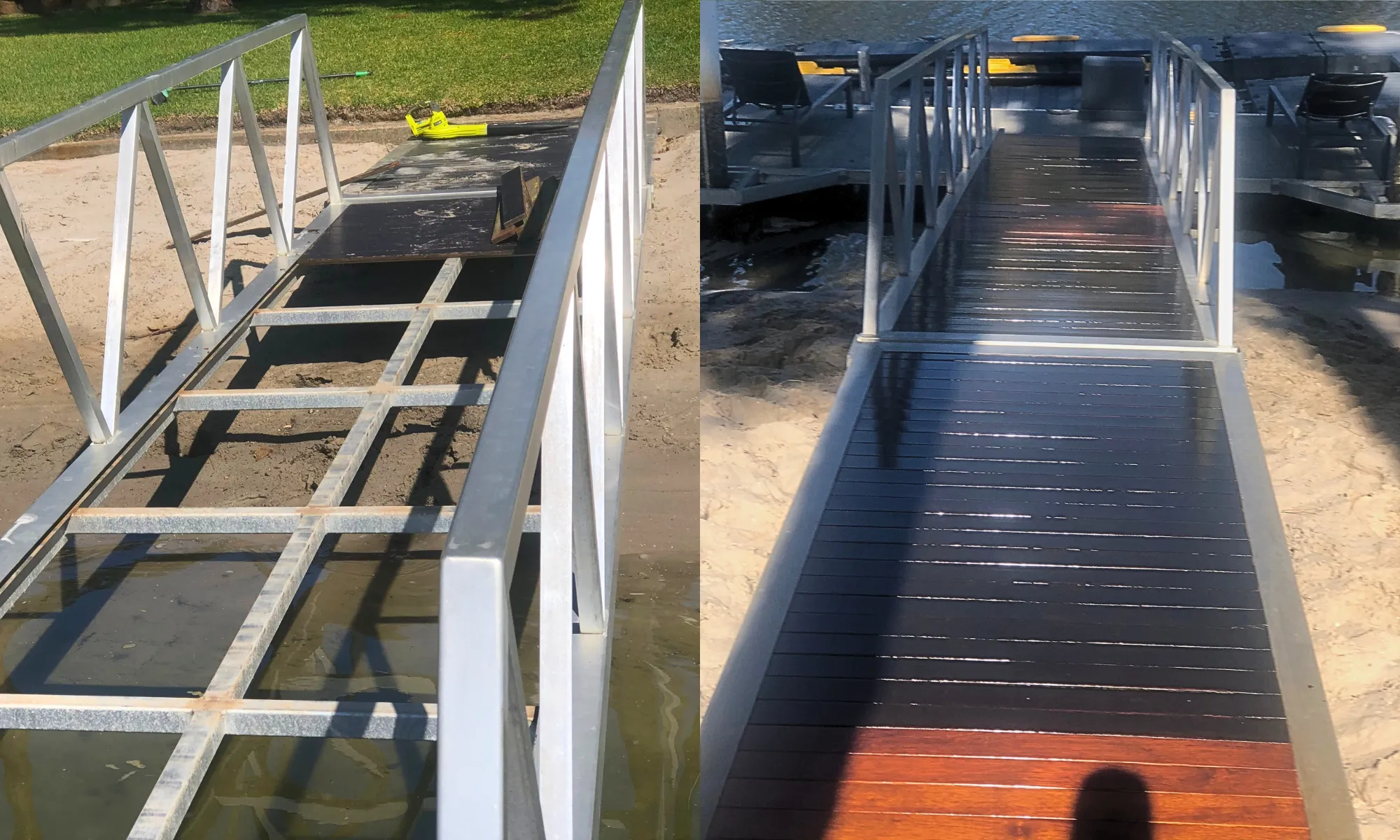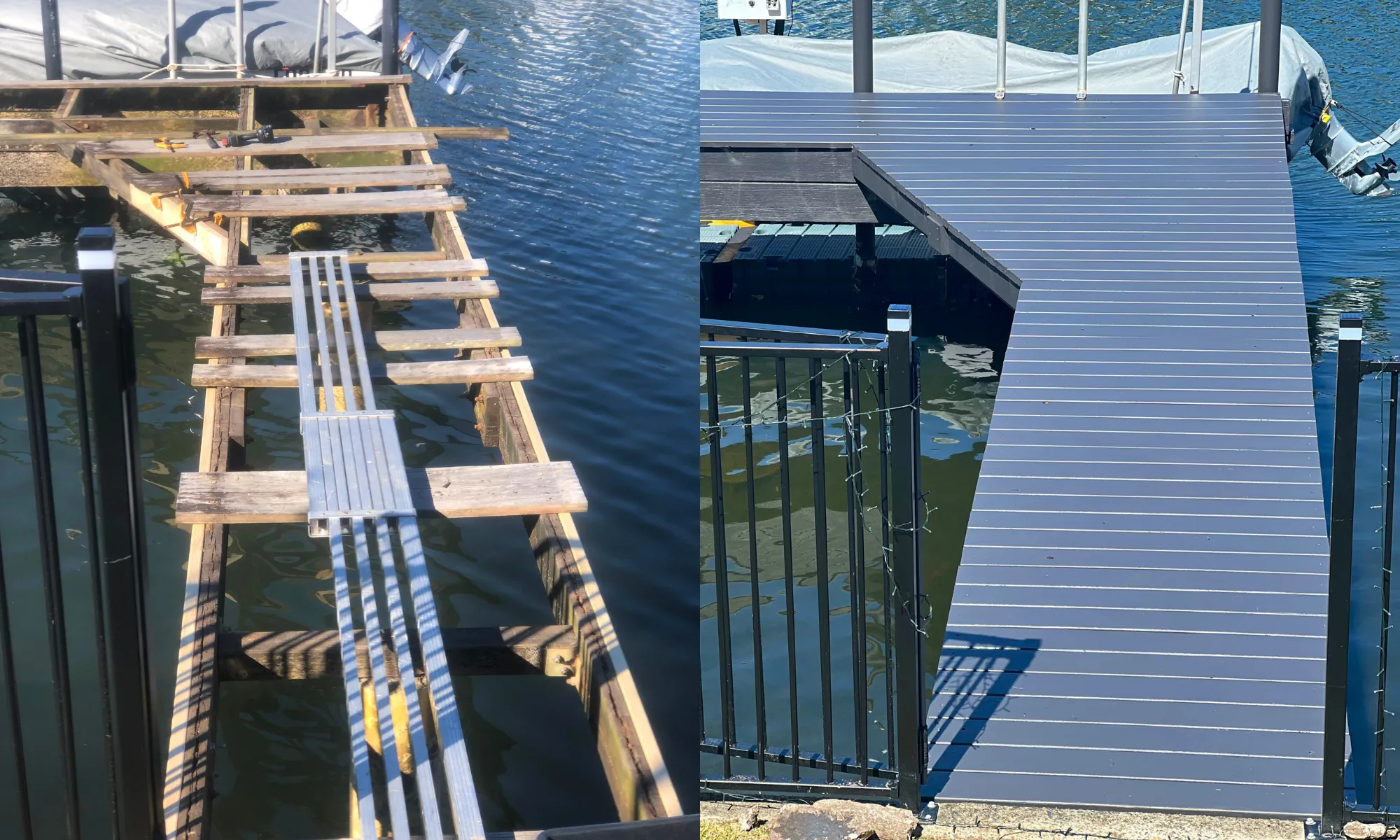

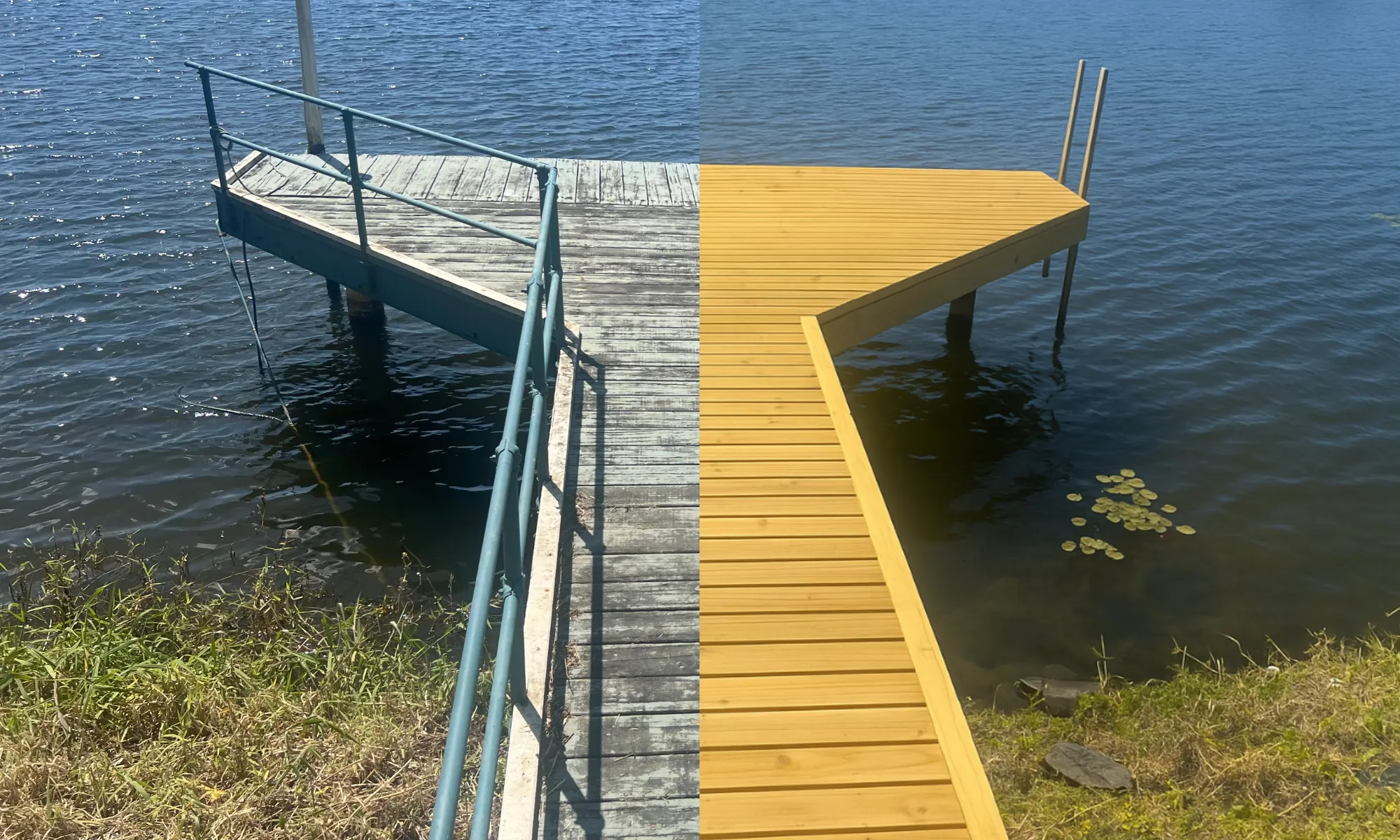

A weathered jetty doesn’t always need new boards. Plenty of decks that look past saving from above have years of life left if they’re sanded and oiled properly. Plenty of others look fine and are gone underneath.
Here’s a 15-minute walk-through that tells you which one you’re standing on.
The 15-Minute Inspection
Walk the jetty end to end with a knuckle and a pocket knife. The knuckle taps each board for a hollow note. The knife slips into the timber along the gap edge — if it goes in past 6mm in soft timber, that board’s done. Note the boards that fail either test, then count them as a percentage of the deck.
Six Tells the Board Can Still Be Restored
Save it when:
- Surface is grey or splintery but the board still feels solid underfoot.
- Knife test sinks less than 4mm into the side grain.
- No more than 30% of the boards show issues.
- Board ends are intact and haven’t lifted from the joist.
- Joists underneath are solid (knock test).
- Cracks are surface-level checking, not structural splits.
Six Tells the Board Is Past Saving
Replace it when:
- Knife sinks past 6mm into the grain — the timber is soft right through.
- Hollow tap — the underside has rotted out even if the top looks fine.
- Boards lift, sag or flex underfoot.
- Salt damage extends to fixing holes — fixings won’t hold a re-drive.
- More than 50% of the deck shows multiple symptoms.
- Boards have shifted laterally on the joists from cycle expansion.
When the Deck Is Mixed
A jetty with 15–25% bad boards is the most common job we see. We replace the failed boards selectively, sand the whole deck back to even tone and oil over the lot — so the new boards aren’t sitting next to bright old ones for the next two years. The trick is matching species and grain so the patch reads as one deck once oiled.
The Sanding Sequence
A proper sand and oil starts at 40 grit to take off weather, drops to 80 grit for the smoothing pass, then 120 grit for the final tone. We dust-vacuum between grits and let the timber sit for 24 hours before oil. Two penetrating coats, wet-on-wet on the second, and the deck cures for 48 hours before traffic.
A Sorrento Jetty Mid-Refresh
A Sorrento owner asked us to quote a full re-deck on a 12m jetty. The boards looked grey from the house. After a 15-minute inspection, only 4 of 38 boards failed the knife test. We replaced those four, sanded the whole deck and oiled in a honey-toned penetrating finish. The owner avoided a full re-deck and got another decade out of the structure.
Choosing the Right Path
A full sand-and-oil is the lightest scope of the three options — usually a two-day job on a typical finger jetty. Selective replacement plus sand-and-oil is a step up, and the most common job we see on Gold Coast jetties at the 10–15 year mark. A full re-deck is the heaviest, reserved for decks where more than half the boards have failed. The right call is whichever lasts longest for the work involved — and that comes down to the inspection, not the look from the house.
A jetty inspected properly often saves you a full re-deck, sometimes for years. If your jetty looks past it from the lawn but you’re not sure, the YardTaskers jetty team will do an on-site inspection and tell you honestly which path makes sense, in writing.